
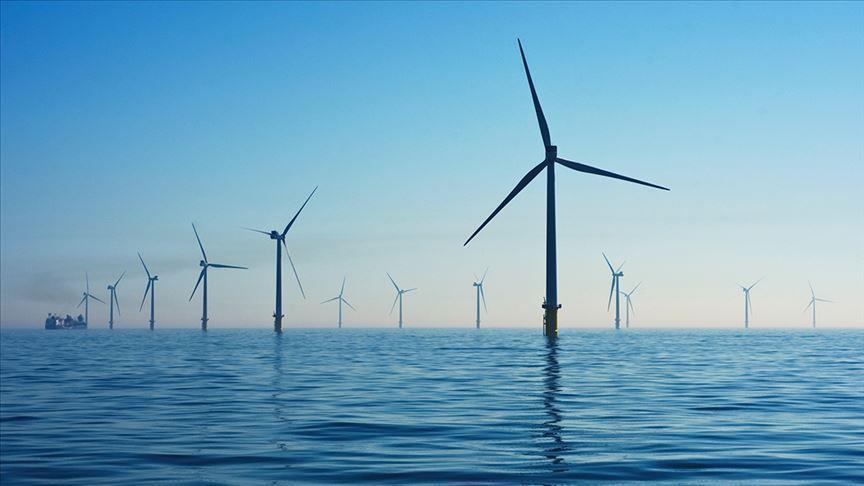
No new floating offshore wind energy capacity was added globally in 2025, marking the first year without commissioning since 2015, according to Global Wind Energy Council’s (GWEC) report on Tuesday.
The development points to a temporary slowdown in the sector’s growth trajectory, GWEC said in its Global Offshore Wind Report 2026.
Floating wind is considered one of the most advanced emerging renewable energy technologies, combining floating platforms, dynamic mooring and cabling systems, hydrodynamic engineering, and next-generation offshore grid infrastructure.
The report said that between 2002 and 2022, floating wind technologies accounted for half of the 17,000 patent families published in offshore wind energy, reflecting an average annual growth rate of %18.
However, in recent years, macroeconomic and policy-related challenges have negatively affected the sector, leading to significant downward revisions in global capacity projections.
Despite the slowdown, project activity continues in several regions.
In Japan, the 16.8-megawatt Goto Offshore Wind project completed turbine installation last year but is expected to begin commissioning in early 2026.
In France, three floating wind projects with a combined capacity of 65 megawatts (MW) are currently under construction, while a 16-megawatt floating prototype in China is also ready for commissioning. These four projects are also expected to come online in 2026.
In addition, at the end of 2025, total net installed floating wind capacity worldwide reached 278 MW.
Norway led with 101 MW, followed by the United Kingdom with 78 MW, China with 40 MW, France with 27 MW, and Portugal with 25 MW.
“Japan and Spain recorded 5 MW and 2 MW, respectively,” the report said.
Floating wind technology is increasingly seen as a key solution for harnessing offshore wind resources in deep-water areas where fixed-bottom turbines are not feasible.
“By enabling access to stronger and more consistent wind regimes further offshore, the technology offers higher capacity factors and improved energy yield stability,” according to the report.
In addition, its deployment farther from coastlines helps reduce visual impact and pressure on coastal ecosystems and tourism, positioning floating wind as both an energy generation solution and a sustainability-oriented offshore development strategy.
