
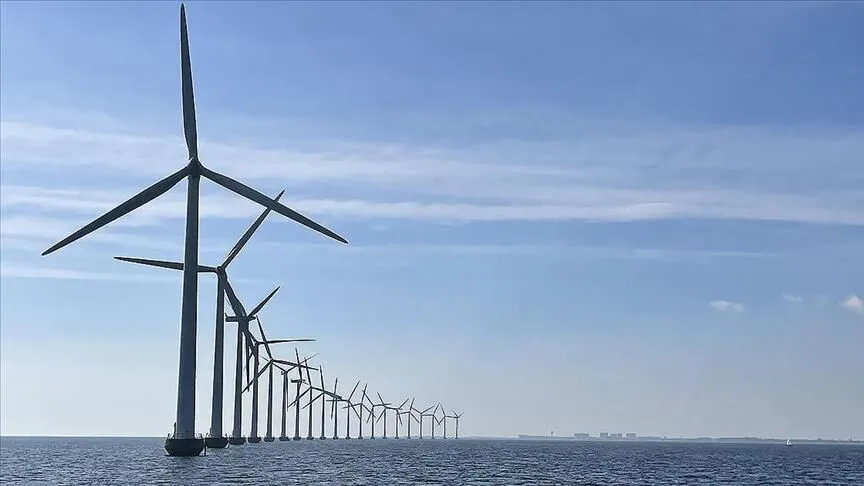
Türkiye’s first offshore wind Renewable Energy Resources Zone (YEKA) tender will be a key test of whether the country can turn its ambitious 5-gigawatt offshore wind target for 2035 into actual projects, investments and a new domestic industry.
According to information compiled by Anadolu from GlobalData, offshore wind energy could become one of the cornerstones of Türkiye’s renewable energy development if supported by robust policies, strong incentives and effective implementation.
Türkiye’s broader renewable energy strategy aims to increase the combined installed capacity of solar and wind power to 120 gigawatts (GW) by 2035.
Offshore wind capacity is expected to enter Türkiye’s electricity generation portfolio in 2032, while 1.3 GW of offshore wind capacity is projected to be operational by 2035, generating approximately 2.7 terawatt-hours (TWh) of electricity.
– 5-GW target faces major development hurdles
Türkiye has identified four candidate offshore wind zones: the Gulf of Saros, Gökçeada, Bozcaada and Edremit.
The government aims to reach 5 GW of offshore wind capacity by 2035. However, the gap between that target and the 1.3 GW projected by GlobalData highlights the challenges facing the sector.
One of the biggest obstacles is the permitting process.
Offshore wind projects require environmental assessments, seabed approvals and maritime permits, often involving several institutions. Delays in these processes can increase project costs and make investment decisions more difficult.
Grid infrastructure is another major challenge.
Projects need connections to the electricity grid, subsea cables, landfall facilities and upgrades to the existing onshore network. These investments need to be planned well before turbines begin operating.
Failure to prepare the necessary infrastructure in advance could create bottlenecks and delay projects, according to the analysis.
Financing is also a concern. Inflation, exchange-rate movements and supply-chain disruptions can increase costs and make large offshore projects harder to finance.
Developers also face technical and environmental challenges, including different seabed conditions, severe marine weather, ecological concerns and objections from local stakeholders.
Despite these hurdles, offshore wind could create opportunities for developers, turbine manufacturers, engineering and construction companies and investors as Türkiye develops a new segment of its renewable energy industry.
The offshore YEKA model could also support early investment in priority areas, increase local production, simplify project development and encourage hybrid renewable energy projects.
Stable electricity generation could create additional value through grid services, corporate power purchase agreements and potentially electricity exports.
– First tender could shape Türkiye’s offshore wind industry
Commenting on the analysis, GlobalData Senior Energy Analyst Attaurrahman Ojindaram Saibasan said the launch of Türkiye’s first offshore wind YEKA tender marked a turning point.
“This marks a shift beyond onshore renewable energy resources. If well planned, with clear rules and permits completed on time, it can mobilize investment, provide clean and reliable electricity and help reduce the country’s reliance on thermal generation,” he explained.

Alper Kalayci, honorary chairman of the Energy Industrialists and Businesspeople Association (ENSIA) and Board Member of the Offshore Wind Energy Association (DURED), told Anadolu that the gap between Türkiye’s 5 GW offshore wind target for 2035 and projected deployment was an important warning.
Kalayci said the first 1,000 MW YEKA tender would be a critical test for Türkiye’s offshore wind ambitions.
“The first project should be seen not simply as a power plant, but as a launchpad for the investment model, supply chain and domestic industrial base that will underpin future projects,” he said.
Türkiye’s strong onshore wind supply chain and industry experience could help accelerate offshore wind development, Kalayci said, adding that success should be measured not only by electricity prices but also by industrial capacity, technology transfer, jobs and export opportunities.
Kalaycı said Türkiye should look beyond the initial 1 GW and establish a predictable long-term project pipeline.
“If Türkiye sets out a clear offshore wind roadmap for the next five to 10 years, the sector could strengthen energy security while creating a new industrial and export base,” he added.
