
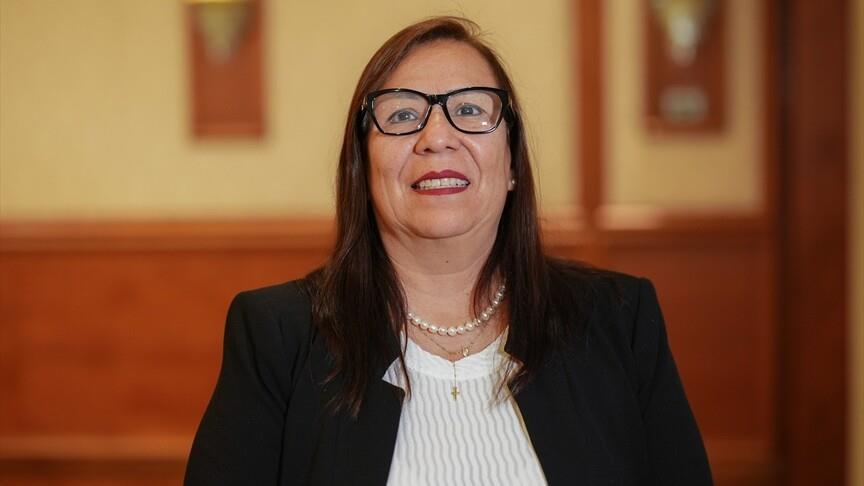
Peru is ready to strengthen cooperation with Türkiye in critical minerals, mining and industrialization as global demand rises with the energy transition, Peru’s environment minister told Anadolu.
Nelly Paredes del Castillo told Anadolu on the sidelines of the OECD Critical Minerals Forum held in April in Istanbul that Peru is very pleased with the possibility of initiating closer cooperation with Türkiye in sustainable mining and industrial development.
“We are truly hopeful about carrying out joint work together,” she said, thanking Türkiye and the OECD for organizing the forum focused on critical minerals and the energy transition.
She said the event provided an opportunity to discuss cooperation on renewable energy and critical minerals, which she described as increasingly important in the global shift toward cleaner energy systems.
“Critical minerals play a very important role, especially for Peru as the world’s third-largest copper producer,” she said, adding that this creates significant opportunities for the country to help meet rising global demand.
Paredes del Castillo said she met with Türkiye’s Energy and Natural Resources Minister Alparslan Bayraktar during her visit to Istanbul and discussed possible cooperation areas between the two countries.
“We agreed on the importance of sustainable development and the need for orderly and responsible mineral extraction,” she said.
Peru and Türkiye are among a growing number of countries seeking to deepen cooperation on critical minerals as global competition intensifies over supply chains needed for clean energy, artificial intelligence, and electric vehicles.
Türkiye has stepped up efforts in recent years to expand its critical minerals production and processing capacity as part of broader goals tied to energy security, industrial development and the energy transition.
– Türkiye to send draft memorandum of understanding through diplomatic channels
She stressed that mining activities must be carried out with respect for water resources, biodiversity and local communities, particularly indigenous and rural communities in Latin America.
“We no longer want to remain only exporters of raw materials,” she said. “We want to create added value by processing and industrializing minerals while ensuring sustainable development and social responsibility.”
Paredes del Castillo said that both parties agreed to strengthen mining cooperation, including the possibility of signing a memorandum of understanding to be coordinated through diplomatic channels.
“We agreed with the minister that Türkiye would send us a draft memorandum of understanding through diplomatic channels so that we can begin coordinating this joint work between the Peruvian and Turkish governments,” she said.
She added that Peru’s transitional government hopes to advance the process before a new administration takes office in July.
“As a transitional government, we have around three months, as Peru will have a new president in July,” she said. “However, we want to leave this process at an advanced stage so the next government can continue negotiations toward signing the memorandum.”
Paredes del Castillo also pointed to rapidly growing demand for critical minerals driven by artificial intelligence and electric vehicles.
“Demand for critical minerals needed for the energy transition is rising rapidly worldwide,” she said.
She noted that Peru launched 67 new mining projects last year involving copper and other critical minerals.
“The rapid expansion of artificial intelligence and electric vehicles is driving global electricity demand significantly higher,” she said, adding that the increase in energy demand also requires the sustainable management of natural resources.
– International coordination on sustainability standards in mining and renewable energy
She emphasized the importance of protecting water resources and biodiversity to ensure resilient and responsible supply chains for critical minerals.
Paredes del Castillo also called for closer international coordination on sustainability standards in mining and renewable energy.
“For us, international cooperation is no longer a complementary element; it has become a necessity,” she said.
She added that countries in what she described as the “Andean Copper Belt,” a group of copper-producing Latin American nations, should work together to align regional activities with high-level international standards, including OECD standards on sustainability and responsible mining.
