
HAMILTON, Canada
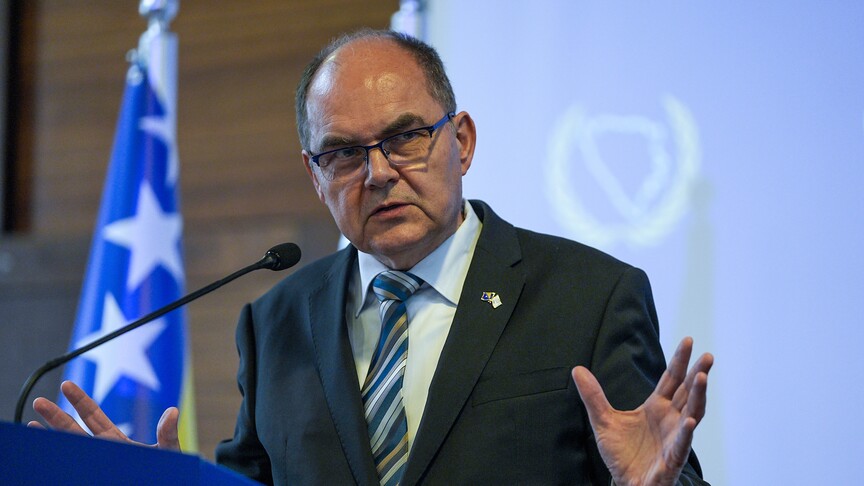
The high representative for Bosnia and Herzegovina announced Tuesday that he will step down from his post in June, as he delivered his last report to the UN Security Council.
“I took my personal decision to end my mandate as High Representative for Bosnia and Herzegovina based on the Dayton General Agreement for Peace and several United Nations Security Council’s Resolutions and which I have received by Decision of the Steering Board of the Peace Implementation Council in 2021,” Christian Schmidt told the Council.
Noting that the process to identify a successor is already underway, Schmidt’s departure comes as Bosnia and Herzegovina faces what Schmidt described as a deepening crisis of governance and institutional functionality.
“I will underline that the country is moving along a narrowing path, one that leads either towards institutional sustainability and consolidation, economic revitalization, the rule of law, and democratic governance standards, or towards further stagnation, driven by political obstruction and the gradual deconstruction of state institutions,” he warned.
While acknowledging that the overall security situation remains stable, Schmidt warned that “potentially disruptive tensions remain an issue of concern.”
“Stability should not be mistaken for institutional health. Even with no imminent security crisis, there is an ongoing crisis of institutional functionality and political responsibility. This affects the quality of governance, economic development and the daily lives of citizens,” he added.
Schmidt outlined four priorities for the current year, including preservation of the institutional order, restoration of institutional functionality, resolution of state property apportionment and ensuring the timely introduction of election technologies ahead of the Oct. 26 general elections.
He also issued a stark warning about the role of Republika Srpska (RS). “The leadership of Republika Srpska continues to question the territorial integrity of Bosnia and Herzegovina and to undermine stability and reform prospects,” he said.
Schmidt also warned that the “persistent denial of the multi ethnic character of the entities, particularly within Republika Srpska, has evolved into a systemic exclusion,” adding that the structural discrimination “not only violates the fundamental rights of non-majority citizens, but effectively hinders the sustainable return of refugees.”
The 1995 Dayton Peace Agreement, which ended the Bosnian War, established Bosnia and Herzegovina as a state composed of two entities — the Federation of Bosnia and Herzegovina (FBiH) and the RS. Disagreements, however, about the interpretation and implementation of the agreement remain a source of contention.
Critics, including US Democratic Sen. Jeanne Shaheen, called the Trump administration’s decision to lift sanctions “reckless and premature,” citing Bosnian Serb leader Milorad Dodik’s ties to Russia, and accusing him of undermining the Dayton Peace Agreement.
Dodik remains under sanctions from the UK.
