
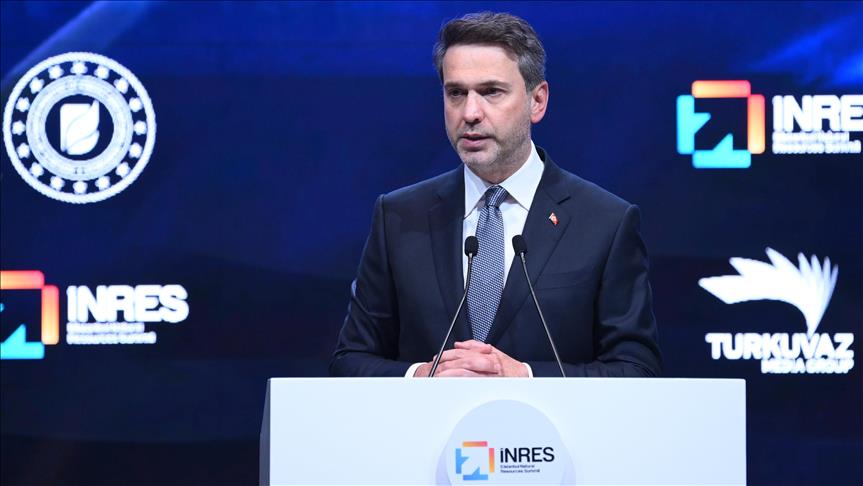
Turkish Energy and Natural Resources Minister Alparslan Bayraktar said Friday that the ongoing conflict in the Middle East had once again underscored the importance of energy security and revealed the fragility of the global economy.
Speaking at the 2nd Istanbul Natural Resources Summit (INRES 2026), Bayraktar said that in an era marked by wars and major economic upheavals, and the entry into the age of artificial intelligence and a succession of major technological advancements, “the world is undergoing a critical energy transition.”
“The recent war centered around Iran has once again demonstrated the importance of energy security and how fragile the global economy can be in this regard,” Bayraktar said.
He noted that Türkiye emerged as one of the best-prepared countries to withstand the crisis thanks to energy policies implemented under the leadership of President Recep Tayyip Erdogan since 2002.
“As Turkey, we are also preparing a new energy architecture for our country in this new era,” he said.
“Our primary goal here is to position Türkiye as a central nation that has ended its dependence on foreign energy, strengthened its energy security, and enhanced regional integration,” he added.
As part of the new energy architecture, he said, Türkiye will take steps to ensure that its natural gas and oil pipelines operate at full capacity.
Bayraktar said that Türkiye will strengthen its energy ties with its neighbors and countries in the region by developing additional infrastructure projects in oil, natural gas, and electricity based on a win-win approach.
“Extending the Iraq-Türkiye Oil Pipeline to Basra and transporting Turkmenistan’s natural gas to Türkiye and Europe via the Trans-Caspian Natural Gas Pipeline will be among the key priorities of this new era,” he said.
– ‘New energy architecture to feature greater connectivity and more infrastructure projects’
Türkiye is also aiming for multi-faceted integration in the electricity sector, Bayraktar said.
“Through the Azerbaijan-Georgia-Türkiye-Bulgaria Green Electricity Transmission Agreement we signed in Baku last year, we aim to deliver renewable energy generated in Azerbaijan to Europe,” he explained.
He noted that the country is also working on a mega power transmission line that will stretch from Saudi Arabia to Türkiye and integrate with neighboring countries in the region. “We believe this will serve as an alternative energy corridor for both our country and Europe.”
Türkiye’s new energy architecture will feature greater connectivity and more infrastructure projects, he added.
“By developing our liquefied natural gas infrastructure, we will be able to supply higher volumes of LNG to Southeast Europe and our other neighbors,” he said.
The one-day INRES 2026 event focuses on “Energy Security in Turbulent Times,” addressing key issues across hydrocarbons, mining, and critical minerals, while highlighting the importance of resilience, innovation, and international cooperation.
