
ISTANBUL
Global markets kicked off Monday with cautious optimism due to developments in the Middle East, monetary policy expectations for the US Federal Reserve, and uncertainties over the profitability of tech firms, while all eyes turned to inflation data to be released worldwide.
Easing selling pressure in the bond market and a decline in oil prices supported global equity markets on Oct. 9, but the start of the new week brought a mixed trend to the fore.
US President Donald Trump and his Russian counterpart, Vladimir Putin, met on Friday and reportedly agreed that Russia would supply millions of metric tons of diesel to the US and global markets.
The US Treasury Department authorized transactions involving Russian diesel, including its sale, delivery, unloading from ships, and import, until April 7, 2027.
Moscow announced that the ban on diesel fuel exports had been partially lifted under the agreement with the US.
Trump said a ceasefire had been reached between Russia and Ukraine on Oct. 11, especially concerning attacks on energy infrastructure.
December-delivery Brent crude oil dropped 1.2% to $103.4 a barrel.
Over the weekend, Iranian-backed Yemeni Houthi militias targeted Riyadh and Dammam airports in Saudi Arabia, alongside two energy plants in the country’s east.
Medium- and long-term risks to oil prices are expected to continue given the geopolitical developments.
The US bond market is not trading on Monday as the country observes Columbus Day.
Meanwhile, the Fed’s new report showed that median household income and net worth increased between 2022 and 2025, but the rate of stock market participation fell.
The International Monetary Fund and the World Bank will discuss the global economy’s challenges at their Bangkok meeting on Monday, and these meetings will continue through Oct. 18.
The UN Conference on Trade and Development warned that global growth could slow to 2.6% in 2026, while expecting a 4% rise in trade in goods and services. The organization’s recent report expects the global economy to grow 2.7% in 2027, while forecasting 4% growth for developing countries, down from 4.7%.
The US dollar is trading just below its previous close at 102.2, while gold barely moved at $4,195 per ounce on Monday.
Corporate financial results will influence market direction this week.
US inflation is expected to accelerate with rising energy costs, but if inflation does not accelerate as expected, Fed officials may adopt a dovish stance at the October meeting, reassuring the markets.
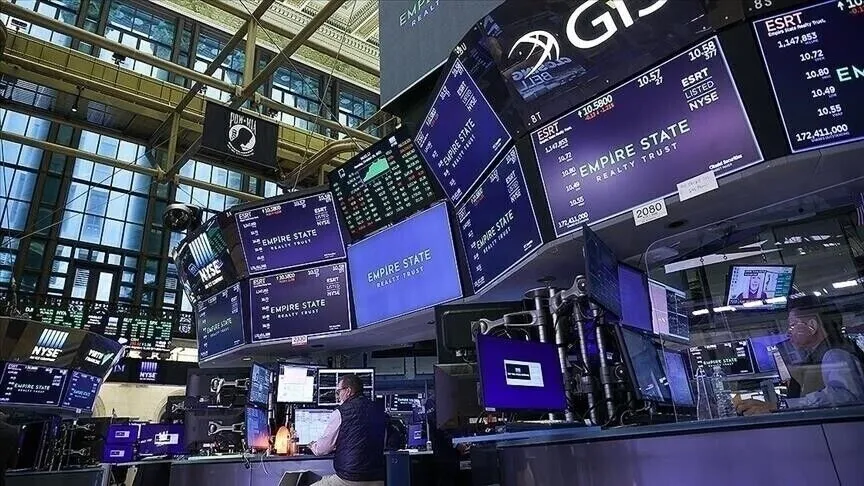
On Oct. 9, the New York Stock Exchange traded positively as geopolitical risk expectations eased.
SpaceX shares gained 1.3% after a deal to acquire a low-band frequency spectrum portfolio covering the US, expected to pave the way for Starlink Mobile to become a major carrier in the country.
The deal put pressure on competitors, as AT&T lost 9.9%, T-Mobile shares dropped 13.3%, and Verizon shares fell 8.8% at the open.
The University of Michigan’s consumer confidence index fell 46.3% in October, below estimates, marking the lowest level since May.
The Dow Jones Industrial Average gained 0.83%, the S&P 500 rose 0.59%, and the Nasdaq Composite was up 0.64% on Oct. 9.
Meanwhile, European stock markets traded positively amid a new deal between the EU and China on halving hybrid vehicle exports, improving European access to the Chinese market, and streamlining export licenses for rare earth elements.
Germany’s bankruptcies reached 2,373 businesses in July, while corporate bankruptcies rose 8% year-on-year, according to Destatis.
Standard & Poor’s affirmed the UK’s credit rating at “AA/A-1+,” maintaining a stable outlook.
Italy’s FTSE MIB 30 gained 0.91%, Germany’s DAX 40 gained 1.13%, the UK’s FTSE 100 jumped 1.06%, and France’s CAC 40 was up 0.95% on Oct. 9. European indexes started Monday on an upward trend.
Near Monday’s close, Asian equity markets traded mixed due to lingering uncertainty over the Russia-Ukraine ceasefire, while geopolitical risks in the Middle East continued.
All eyes turned to the earnings report from TSMC, Taiwan Semiconductor Manufacturing Company, to be released on Thursday.
South Korea’s Kospi dropped 2.7% and China’s Shanghai Composite fell 0.1%, while Hong Kong’s Hang Seng rose 0.2%. Japanese markets were closed due to a holiday.
