
ISTANBUL
Sports competitions occupy a distinct place in our collective memory. They carry their own associations, emotional weight, and a hierarchy of meaning. With the World Cup set to kick off across the Americas, for example, many fans in our part of the world will once again stay up until dawn to watch matches broadcast from thousands of miles away. We should also remember that an entire generation spent its childhood and youth watching Olympic competitions live on TV. Today’s parents, who try to keep their children away from the chaos of the digital world, speak of those days with nostalgia. Yet, few of us ever pause to interrogate the supposed “neutrality” or underlying “ideology” of the Olympic Games.
Like many institutions born from the dominant Western modernity, the global sports ecosystem claims to rest on the pillars of “neutrality” and “fairness in representation.” However, the reality of global sport has rarely mirrored these ideals. Sport has always been bound by social frontiers, forging a direct conduit between the past and the present. But we must ask: whose past, and whose present?
For over a century, athletes of diverse races and geographies have competed within a framework of meaning and bodily discipline dictated by the West. Global audiences have internalized the ethics of competition and the rules of play through a hierarchy shaped by Western cultural values, accepting them as universal benchmarks of the past and present. Cultural hegemony, after all, does not operate in a vacuum; it is an active, relational negotiation with societies. From a Hegelian perspective, the spectator, despite achieving a form of self-awareness, remains excluded from a genuine relationship with the dominant culture and the rule-maker. The dynamic is inherently one-sided.
The spectacles, performances, and actors granted visibility and institutional approval inevitably shape our subjective experiences of phenomena we otherwise accept as objective. Everything from dietary habits to physical symbols is produced by the dominant culture and subsequently absorbed by others. This assimilation is driven not merely by media and mass communication, but by the structural pillars of global economics, political alignment, and the enduring legacy of colonialism.
Paths that converge and diverge
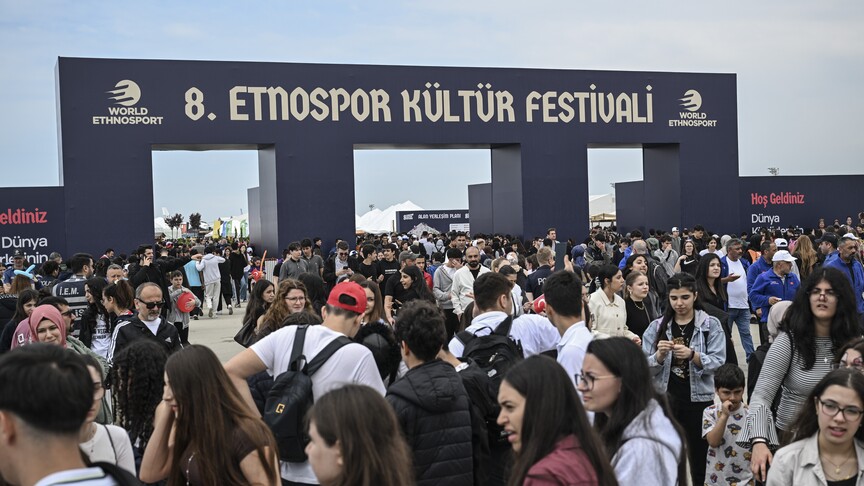
When we evaluate the Ethnosport Culture Festival (celebrating its eighth iteration this year), we are examining something far deeper than traditional games, equestrian sports, archery, or the vibrant energy of children on the festival grounds. We are confronting a foundational question: Who defines sport? Which cultures are deemed “universal,” and which are marginalized as mere folkloric footnotes? How does the modern world hierarchically classify human culture?
Western-centric sports organizations, most notably the Olympics, have long served as stages not just for athletic excellence, but for assertions of modernity, civilizational supremacy, body politics, and the colonial gaze. While the Olympic ideal is wrapped in the vocabulary of peace, fraternity, and universality, this universality was constructed on terrain where the West projected its provincial values as the shared heritage of humanity.
The modern Olympics emerged in the nineteenth century, at a time when Eurocentric colonial empires dominated the global order. It was an intellectual climate obsessed with classifying nations, cultures, and bodies into hierarchies. The white European physique was associated with discipline, reason, measure, and superiority, while non-Western societies were cast as exotic, backward, or primitive targets for “development.” Consequently, the Olympic Games functioned less as a globalization of sport and more as the universalization of Western paradigms of competition and physical discipline.
The most egregious manifestation of this was the 1936 Berlin Olympics, which Nazi Germany brazenly weaponized as a propaganda machine. Sport was stripped of its competitive innocence and transformed into a spectacle for racial supremacy. While some may dismiss this as an extreme, historical aberration, it forces us to ask: Is the ease with which an apparently “innocent playing field” can be converted into a powerful ideological apparatus not inherently tied to its conceptual foundation?
Indeed, this tension persists. In recent years, debates surrounding gender identity, biological categories, the boundaries of women’s sports, dress codes, and the headscarf have turned Western sports competitions into ideological lightning rods. No longer just a vehicle for civilizational ideals, sport has mutated into a primary arena for identity politics. Critical questions regarding the protection of women’s categories, biological reality, inclusion, and competitive fairness have triggered a profound structural crisis. The controversies surrounding Paris 2024 demonstrated that these cultural fault lines have acquired an ideological gravity that technical decisions by sports federations can no longer resolve.
A question about sport
Today, contemporary sports sociology universally acknowledges that sport is neither insulated from politics nor free from ideology. This intersection is most visibly scrutinized in global football, where the clash of “your football” versus “my football” opens a fierce arena of representation. The Ethnosport Culture Festival, however, consciously steps outside this binary of ownership. It does not seek to be “our version” of a Western model, nor does it position itself as a reactionary counterfeit.
Instead, alongside ancient themes of health, vitality, and performance, Ethnosport revives a fundamental question that the commercialized sports industry has obscured: Does sport exist to detach human beings from their roots, or to reconnect them with their culture, family, heritage, nature, and historical memory?
The vision championed by the World Ethnosport Confederation centers on the principles of tradition, respect, solidarity, and peace. In the contemporary sports industry, hyper-financialized success has become the sole metric of worth: running faster, winning more, securing exorbitant transfers, and generating astronomical ad revenue. The intrinsic meaning of sport has been trapped within market dynamics and ideological spectacles.
Traditional sports offer an alternative philosophy. Particularly within Turkish history, the philosophy of play recognizes that the human being is not merely a physical machine, but a vessel of meaning. Equestrianism, archery, “gökbörü,” and javelin require physical discipline, but they are designed to cultivate courage, humility, and communal solidarity.
From ‘toy’ culture to the metropolis
The eleventh-century scholar Mahmud al-Kashgari famously noted, “The horse is the Turk’s wing,” a phrase that signifies not just physical mobility, but future conquests and expanding horizons. A people with wings possesses a destination.
The revival of traditional sports across the Turkic world is not a mere exercise in nostalgia. If its underlying philosophy is fully grasped, it offers a framework to break through contemporary ideological sieges, tracing a path from the “toy” (the traditional gathering and celebration in Turkic history) to the modern metropolis. Ethical competition, a holistic worldview that reunites the body with the soul, and a culture of solidarity can inject a fresh spirit into our current age of global uniformity. Furthermore, safeguarding the innocence of play in childhood is vital for cultural belonging. Through these games, children engage directly with their own history rather than viewing themselves through the lens of an external cultural hegemony.
We live in an era of hyper-homogenization, where globalization erodes the collective memory of societies. If one were to travel the world navigating only through modern airports, it would be nearly impossible to distinguish one metropolis from another. This standardization, while functional for transit infrastructure, is toxic when applied to a society’s culture, aesthetics, morals, and physical traditions. Globalization does not require the erasure of identity; on the contrary, the shared future of humanity is enriched only by the preservation of its pluralism.
In this context, Ethnosport is not a defensive redoubt built out of reactionary anti-Western sentiment. Rather, it is an affirmation of a multi-centered humanity, a defense of cultural diversity against the twin engines of market reductionism and ideological conformity. Against the transformation of human movement into a commercialized spectacle, it seeks to restore meaning to the body, measure to competition, and dignity to culture.
Ultimately, sport shapes identity just as it shapes the physique. Ethnosport should therefore be understood not merely as a festival, but as an intellectual and civilizational response to the cultural crises of our age. Against a sporting order long dominated by Western-centric, exclusionary claims to universality, Ethnosport offers a more rooted, pluralistic, and humane alternative. This is neither a retreat into historical escapism nor a rejection of modernity. It is a new vision of sport—one that is at peace with its roots, anchored in its culture, guided by morality, and designed to view the human being through the lens of belonging rather than mere performance.
*Opinions expressed in this article are the author’s own and do not necessarily reflect the editorial policy of Anadolu.
