
İSTANBUL
- Global nuclear inventory stood at estimated 12,187 warheads in January 2026, according to SIPRI
- ‘Most leaders in most countries now feel like the world is becoming a less safe place,’ senior policy director at Center for Arms Control and Non-Proliferation, tells Anadolu
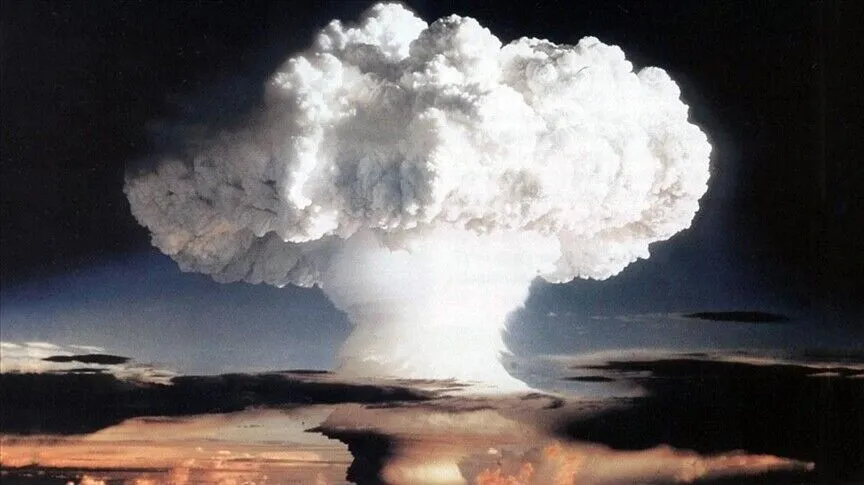
Eighty-one years after the US conducted the world’s first nuclear weapons test, the risks posed by nuclear weapons have become more complex with the rise of artificial intelligence-enabled military systems.
The Trinity test, conducted in New Mexico on July 16, 1945, marked the beginning of the atomic age. Less than a month later, the US dropped atomic bombs on Hiroshima and Nagasaki.
Today, nine nations possess nuclear weapons.
“Most leaders in most countries now feel like the world is becoming a less safe place,” John Erath, senior policy director at the Center for Arms Control and Non-Proliferation, told Anadolu.
“And more leaders are thinking that military means are the best way to ensure safety.”
According to the Stockholm International Peace Research Institute’s (SIPRI) latest findings, the US, Russia, the UK, France, China, India, Pakistan, North Korea and Israel continued modernizing and enhancing their nuclear arsenals in 2025.
How many warheads?
The global inventory stood at an estimated 12,187 warheads in January 2026, including 9,745 in military stockpiles for potential use, according to SIPRI
Around 4,012 warheads were deployed with missiles and aircraft, while between 2,100 and 2,200 deployed warheads were maintained on high operational alert aboard ballistic missiles, the think-tank added.
Erath said the current situation differs from the Cold War, when nuclear competition was dominated by the US and the Soviet Union.
“It’s not exactly the same as during the Cold War,” he said. “Then you had two blocs led by a superpower which had thousands and thousands of nuclear weapons. Now there are nine nuclear states.”
China leading the race
China is expanding its arsenal faster than any other nuclear-armed country, according to SIPRI, which estimates that Beijing possesses around 620 warheads.
“If it’s a race, there’s only one person running, and that’s China,” Erath said.
“The US and Russia are modernizing their nuclear weapons. They’re improving some of the weapons they do have. In the case of Russia, they’re developing new types of weapons, but they’re not increasing numbers.”
However, he warned that China’s buildup is increasing pressure in Washington for the US to expand its own arsenal, potentially creating a three-way arms competition.
“In Washington, there are people saying already that the US needs to build more nuclear weapons because China is doing so,” he said.
AI adds new layer of uncertainty
Nuclear-armed states are increasingly investing in military AI.
A SIPRI study published in 2025 warned that AI could affect nuclear escalation even when it is used outside nuclear weapon systems.
AI-enabled decision-support systems can rapidly process information from satellites, sensors, databases and open sources. They may improve situational awareness, but they can also produce flawed, biased or opaque assessments.
During a crisis, those systems could compress decision-making timelines and encourage officials to act before information has been fully verified.
The SIPRI study identified automation bias — the tendency to accept a system’s output without sufficient scrutiny — as a major concern.
It also warned that AI systems may be vulnerable to technical failures, cyberattacks, manipulation and “hallucinations,” in which a system generates inaccurate information.
Such weaknesses could lead officials to misidentify an attack, misunderstand an adversary’s intentions or respond to a false warning.
The danger is particularly serious because some US and Russian nuclear forces remain on launch-on-warning status, allowing weapons to be launched within minutes of detecting a presumed attack.
Arms control mechanisms weakening
These technological developments are unfolding as nuclear arms control mechanisms deteriorate.
The New START treaty, the final major agreement limiting US and Russian strategic nuclear forces, expired in February 2026.
Erath said Washington and Moscow should continue observing their numerical limits and restore information exchanges and transparency mechanisms.
“Having some kind of confidence that the other side is not building nuclear weapons would be helpful,” he said.
Any future arms control framework would eventually need to include China, he added.
For Erath, the greater danger is that governments increasingly view larger arsenals as a guarantee of security.
“The false assumption is that it is mathematical, that more weapons equals more deterrence,” he said. “One nuclear weapon is enough to deter.”
After all, “nobody wins an arms race,” said Erath.
