
ISTANBUL
With calls growing for reform at the United Nations, UN General Assembly High-level Week 2023 recently concluded without any solutions to the woes surrounding the catastrophic effects of climate change and little progress in Sustainable Development Goals (SDGs).
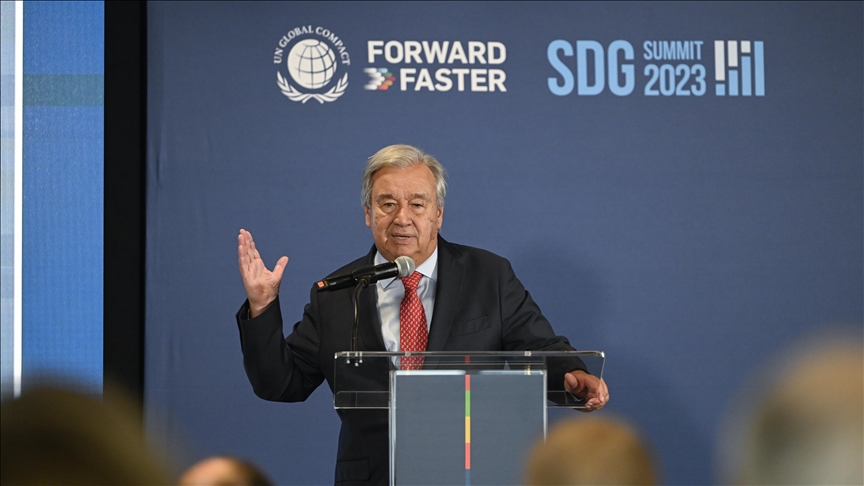
One of the highlights from the event was UN Secretary-General Antonio Guterres’ speech, in which he emphasized the need to modernize the multilateral system.
“It’s reform or rupture,” Guterres said, adding the world is “becoming unhinged.”
“Let us be determined to…come together for the common good,” he said, underlining that the raison d’être of the UN is to resolve global crises during times of “maximum danger and minimum agreement.”
Even US President Joe Biden, as the head of state of one of the permanent members of the UN Security Council, called for reform.
“We need to be able to break the gridlock that too often stymies progress and blocks consensus on the Council. We need more voices, more perspectives at the table,” he said.
“The United Nations must continue to preserve peace, prevent conflict and alleviate human suffering. And we embrace nations stepping up to lead in new ways, to seek new breakthroughs on hard issues,” Biden added.
Prof. Nursin Guney, an international relations expert and academic, spoke to Anadolu on the need for UN reform.
“There have been many demands for reform by many international leaders including President Recep Tayyip Erdogan,” Guney said, referring to the Turkish leader’s famous “the world is bigger than five” motto that criticizes the UN Security Council’s structure, which only grants the right to veto for its five permanent members — the US, China, Russia, the UK and France.
“When a global threat emerges, it is usually impossible to respond properly due to the fact that any possible move can be vetoed by any of those five members over clashing interests,” she said.
“The atmosphere was basically the same during the times of the Cold War. The structure of the UN Security Council, which was set up after World War II, is insufficient to find solutions to today’s problems.”
Noting that representation is a huge problem at the Security Council, Guney said a new structure is needed in which “rising powers” and continents as a whole have a say.
“Africa is basically silent. So are some very important countries in Asia,” she said.
“The five big powers do not want any change in the structure of the UN Security Council. That’s why it’s too hard to implement reforms,” Guney underscored, adding there is growing dissent.
“Some mechanisms in the UN continue their efforts to implement reforms and they are trying to find solutions,” she added, giving the example of the “Coffee Club,” the nickname of the Uniting for Consensus Group (UfC), which was formed in the 1990s by a group of countries from different regions of the world that has been advocating for many years for comprehensive reform of the Security Council.
“The current structure of the UN leads to many unsolved problems,” she added.
Sustainable Development Goals: Distant prospects
The Sustainable Development Goals (SDG) Summit, which also took place during the high-level week, emphasized a “global plan of action to drive economic prosperity and social well-being while protecting the environment,” even though the pledge currently seems like a distant prospect.
Secretary-General Guterres pointed to the “climate chaos” during his speech at the General Assembly.
“We cannot afford the same old broken record of scapegoating and waiting for others to move first,” he said.
“And to all those working, marching and championing real climate action, I want you to know: You are on the right side of history. I’m with you. I won’t give up this fight of our lives,” he added.
Nevertheless, the goals are far from being achieved, as data on different SDG metrics show a grim picture.
Even members of the Organization for Economic Co-operation and Development (OECD), which is comprised of mainly developed nations, are “advancing slowly,” according to a report by the group.
“Despite progress made since the adoption of the 2030 Agenda for Sustainable Development and its 17 Goals (SDGs), OECD countries have met or are close to meeting only a quarter of the targets for which performance can be gauged,” the organization said in a report released last year.
“While OECD countries have eradicated extreme poverty, most of them need to do more to reduce deprivation more broadly. Women, young adults and migrants face greater challenges than the rest of the population, and despite some progress, women’s rights and opportunities are still limited in both private and public spheres,” the OECD’s report titled “The Short and Winding Road to 2030: Measuring Distance to the SDG Targets” says.
With regards to climate change, the report does not offer much hope either.
“Despite progress achieved in decoupling greenhouse gas emissions from population and Gross Domestic Product (GDP) growth, total emissions are hardly decreasing, and all OECD countries are continuing to support the production and consumption of fossil fuels,” the report says.
“As for biodiversity, despite some encouraging developments in protecting ecosystems, threats to terrestrial and marine biodiversity have been rising. Without more determined action, biodiversity loss will continue,” it warns.
