
ISTANBUL
- 639 hydropower personnel in Nepal among missing as 844 foreigners remain unaccounted for on both sides of border
The death toll from flash floods and mudslides in the Himalayas jumped above 1,000 on Tuesday, a week after the natural disaster struck the border region between Nepal and China, according to official data.
According to Nepal’s National Disaster Risk Reduction and Management Authority (NDRRMA), search and rescue teams confirmed 84 more fatalities, taking the death toll on the Nepalese side of the border to 987, while 3,916 people, including 583 foreigners, remained missing.
It added that 639 personnel deployed at hydro power stations were among the missing.
Chinese authorities confirmed 16 deaths, while the search continued for 546 missing people, including 261 foreigners.
Data from the two sides showed that the combined death toll reached 1,003, while some 4,462 people, including 844 foreigners, remained missing.
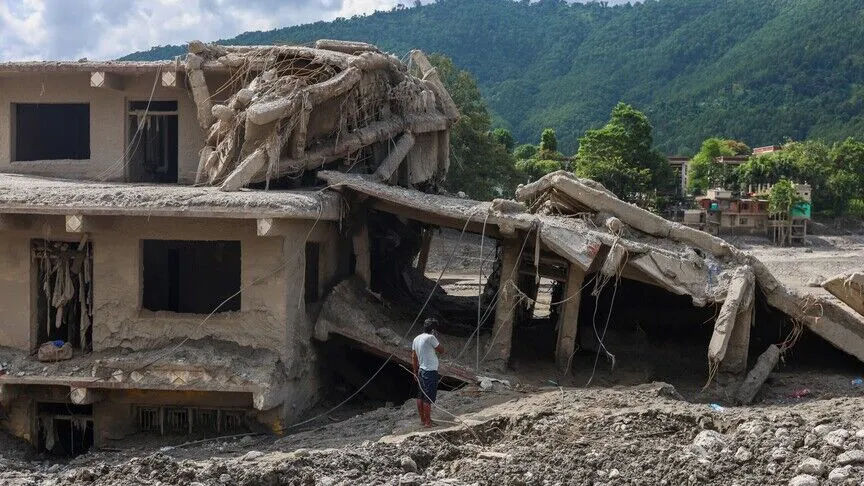
The disaster struck on Aug. 26 when a glacier on Nepal’s Mount Langtang Lirung fractured at an altitude of about 5,200 meters, triggering an ice-rock avalanche that developed into a massive debris flow and swept through valleys along the border.
The huge surge of water, along with mudslides, devastated Rasuwa, Nuwakot, Dhading, Kavre and the Kathmandu Valley in Nepal, while also burying the Gyirong border crossing with Nepal in southwestern Tibet, also known as the Xizang Autonomous Region, on the Chinese side.
Most of the missing foreigners were from India, with 275 Indian nationals and 100 Chinese nationals among those reported missing, according to data shared by the two countries.
With the number of bodies recovered mounting, Nepal has sought freezers, DNA testing kits, remote-sensing technology and drones to map disaster-affected areas.
China, South Korea and India have sent teams to assist with search and rescue efforts.
Rough terrain, damaged roads and critical infrastructure remain major challenges for communication.
Interviews with search and rescue teams by Chinese state media showed that they reached the Gyirong border crossing after a 10-hour walk but found no signs of buildings or other infrastructure on the Chinese side of the border.
