
ISTANBUL
Global markets started the week cautiously as the US, Israel and Iran failed to make concrete progress toward ending the ongoing war.
Geopolitical developments originating from the Middle East continue to determine the direction of the markets.
Ongoing tensions between the US and Iran, along with Israel’s new attacks on Lebanon and statements that the US could impose new economic sanctions on Iran, increased geopolitical uncertainties.
Analysts stated that geopolitical uncertainties were the factor affecting the markets the most, noting that this situation put pressure on risk appetite.
Risk appetite in global markets decreased on Friday after macroeconomic data released in the US last week fell short of expectations.
US retail sales fell 0.6% in July despite expectations of an increase, recording their first decline since October 2025.
The consumer confidence index measured by the University of Michigan also fell to 51 in August, coming in below market expectations.
The combination of weak retail sales figures and weakening consumer confidence raised questions regarding the momentum of consumer spending later in the third quarter.
These figures showed that the US public’s perspective on the economy became more pessimistic and increased concerns about the growth outlook.
Despite signs of slowing inflation in the US throughout last week, the ongoing uncertainty over the agreement process in the Middle East caused risk appetite in global markets to remain limited on Friday.
Estimates that the Fed would not change its policy rate next month strengthened as retail sales also fell following the slowdown in US inflation.
In money market pricing, the probability of the bank raising interest rates in September dropped to 30%, while the possibility of an interest rate hike by the end of the year lost momentum.
Investors will also closely follow the meeting minutes the Fed releases this week.
As expectations for a Fed interest rate hike weakened, the US 10-year bond yield decreased by two basis points to 4.68%, and the dollar index fell 0.2% to 99.5.
An ounce of gold rose 0.5% to trade at $4,396.
The price of a barrel of Brent crude oil for October delivery increased 0.1% to $88.70 due to uncertainties regarding US-Iran diplomacy.
New York stock exchange trends negatively
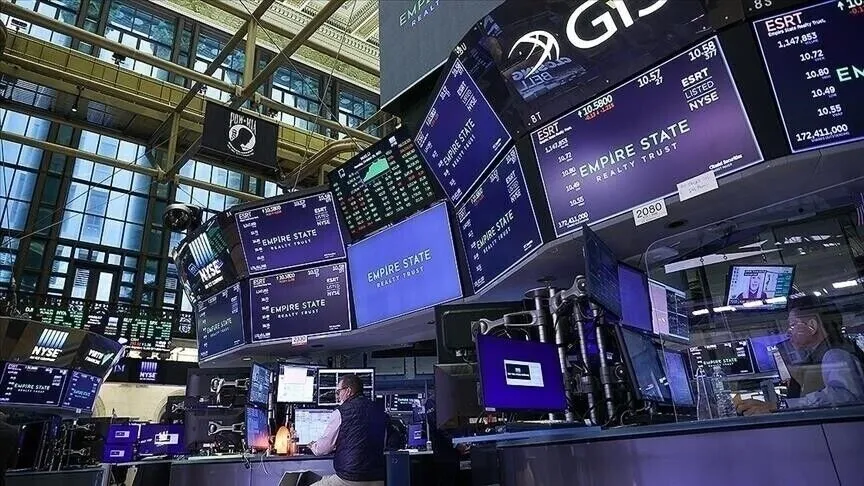
A negative trend prevailed on the New York stock exchange on Friday due to these developments.
Shares of social media platform Reddit ended the day with an increase of nearly 13% after the company announced its inclusion in the S&P 500 index on Aug. 18.
The Dow Jones index lost 0.2%, the S&P 500 index fell 0.17% and the Nasdaq index decreased 0.28%.
Index futures contracts in the US started the day with a mixed trend.
European stock markets trend negatively except in Germany
European stock markets saw a sales-heavy trend on Friday as ongoing geopolitical risks raised oil prices.
Gross domestic product for the second quarter in the eurozone increased 0.4% compared to the previous quarter and 1% on an annual basis, meeting expectations, according to data released on Friday.
With these developments, the FTSE 100 index in the UK lost 0.21%, the CAC 40 index in France fell 0.16% and the FTSE MIB 30 index in Italy decreased 0.2%, while the DAX 40 index in Germany gained 0.53%.
Index futures contracts in Europe started the day with a mixed trend.
Asian stock markets trend positively
Asian stock markets saw a buying-weighted trend on the first trading day of the week, while technology shares found support from decreasing estimates that the Fed would raise interest rates.
Macroeconomic data announced Monday in the region remained at the center of the markets’ focus.
Japan’s GDP for the second quarter increased 0.3% compared to the previous quarter and 1.1% on an annual basis, falling short of expectations.
These figures revealed a slowdown in economic growth in the country, showing that weakening domestic demand limited the positive effects of strong exports.
While the data began to reflect the economic effects of the Iran war, the dollar-yen exchange rate traded at 159.1, down 0.1%.
On the other hand, industrial production in Japan for June increased 1.9% monthly and 4.9% annually, exceeding expectations.
With these developments, Japan’s Nikkei 225 index rose 0.3%, China’s Shanghai Composite index increased 0.8% and Hong Kong’s Hang Seng index gained 1.6% toward the close.
The South Korean stock market remains closed for trading due to a holiday.
