
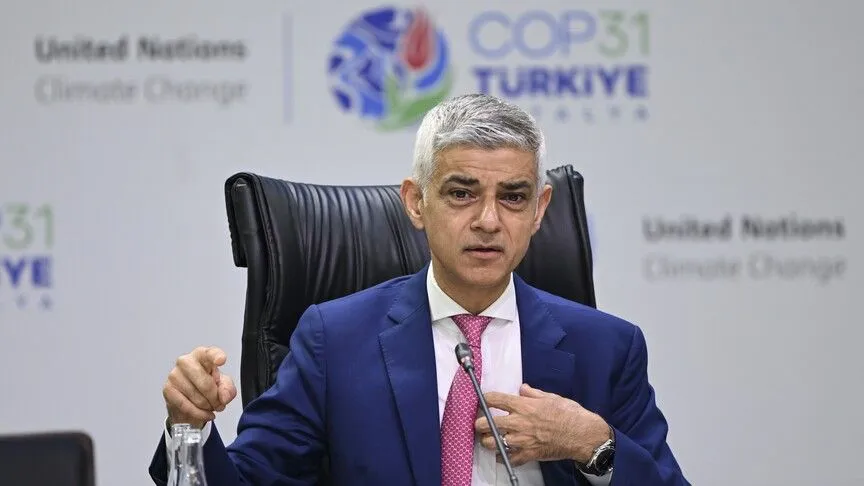
ANTALYA, Türkiye
London Mayor Sadiq Khan said on Thursday a pro-climate agenda can be an electoral asset rather than a political liability, arguing that his environmental policies helped him secure three consecutive terms in office.
Speaking to Anadolu on the sidelines of COP31 in Antalya, Khan said his experience in London showed that voters respond positively when climate policies are properly communicated and deliver tangible benefits.
“One of the things that we’ve realized is actually if you explain your climate change policies in a good way, it’s popular. And we’re really keen to carry on winning our elections,” he said.
“For us, an election is a re-application for our job. And if you’ve got a good CV, you get re-elected. If you’ve got a bad CV, you don’t.”
Khan, who has served as London’s mayor since 2016, said his administration had demonstrated that climate action could be compatible with electoral success.
“And one of the things the public does like is a pro-climate mayor. And we’ve shown in London, we won the first time, the second time and the third time being pro-climate,” he said.
Asked about the prospect of securing a fourth term, he added: “Inshallah, we’ll see.”
Khan also highlighted the role of cities in addressing climate challenges, saying local authorities were increasingly taking action despite frustration with national governments.
“Whereas sometimes we’ve been frustrated by countries and national governments not taking action, cities are taking action,” he told Anadolu.
He described London as having become “greener, safer, healthier, more prosperous and more affordable” over the course of his decade-long tenure.
Istanbul and London cooperation
Khan said he had discussed urban development and climate action with Turkish President Recep Tayyip Erdogan, drawing on Erdogan’s experience as a former mayor of Istanbul.
“I spoke yesterday to your president, who, as you said, was a former mayor of Istanbul, about some of the ideas he has for cities and what he did in his city. Istanbul and London are sister cities. We have a lot in common,” he said.
Khan said he planned to engage with colleagues in Istanbul on possible areas of cooperation as cities confront the growing climate emergency.
He also pointed to the immediate consequences of climate change in London, recalling extreme summer temperatures that disrupted everyday life and public services.
“Heatwaves, temperatures of 40 degrees Celsius, schools having to close down, people not being able to stay in their homes, too hot on the bus, too hot on the tube. So it’s happening now,” he said.
He added that extreme weather was already imposing economic and public health costs.
“It’s costing our economy money. It’s costing health money,” he said, describing COP31 as an important platform for discussions on addressing these challenges.
Khan said London could offer an example of how cities can respond through ambitious environmental policies and practical measures.
Cleaner air and sustainable transport
Recalling his first mayoral election campaign, Khan said experts had warned him that it could take 200 years to bring London’s air quality within legal limits because of pollution.
However, he said the city had made significant progress by adopting ambitious targets and expanding cleaner transport options.
“By stretching aggressive targets, the air is now much cleaner,” he said.
Khan said improved air quality had contributed to fewer people being hospitalized with pollution-related illnesses, fewer premature deaths and improvements in children’s lung health.
He attributed the progress to measures including increased cycling, electric buses and taxis, and the expansion of rail services with lower or zero emissions.
Khan said his ambition was to make London a net-zero city by 2030, but stressed that achieving the target required support from both central government and businesses.
“We need support from the government. We need support from the private sector,” he said.
Oxford Street pedestrianization
Khan also defended the pedestrianization of Oxford Street, which he described as “the nation’s high street,” saying the move was intended to reverse the decline of one of London’s best-known shopping destinations.
The street was fully pedestrianized on Oct. 26, following what Khan acknowledged had been considerable opposition to the decision.
With the project expected to cost £150 million (approximately $200 million), he said the initial results had been encouraging, with record numbers of visitors and improved business for shops.
“In the new year, we’re going to plant new trees in this street, have new benches and transform this street,” he said.
Khan said he hoped the project would encourage other cities to consider pedestrianizing major roads and creating more accessible public spaces.
He envisioned Oxford Street becoming an area where people could dine outdoors, visit cafes and shops, and move around on foot or by public transport rather than private vehicles.
He argued that pedestrian-friendly streets could also support economic activity by helping the retail and hospitality sectors flourish.
Managing London’s growth
Khan said London’s growing population was a sign of the city’s attractiveness, contrasting its continued expansion with population declines in other cities around the world.
“I think one of the reasons why London is growing is because people love London. We’ve been incredibly successful over the last 10 years. Some cities around the world are shrinking,” he said.
He argued that population growth itself was not a problem, provided that cities planned adequately for increasing demand.
“There’s nothing wrong with growth per se, but you’ve got to plan for that growth,” he said.
Khan said his administration was working with the British government to accommodate London’s expanding population, including through financial support for building new homes and investment in infrastructure and public transport.
“We’ve now got financial support to build record numbers of new homes. We’ve got government support to invest in infrastructure and public transport,” he said
