
ISTANBUL
Global markets are trading on a mixed trend despite ongoing peace talks in the Middle East, as expectations of a new conflict erupting in the region due to a lack of concrete results from the dialogue are fueling uncertainty.
Geopolitical tensions that escalated last week somewhat subsided this week, but the lack of positive developments toward lasting peace and the absence of clear signals from Tehran continue to fuel investor fears.
US President Donald Trump told members of the press that negotiations with Tehran resumed on Tuesday and were ongoing, noting that Iran had made contradictory statements about the talks.
Trump said Washington is conducting talks with Tehran with support from Saudi Arabia, the United Arab Emirates, Qatar, and other countries, warning that it is the last chance to make a good deal.
Trump said he had prepared to launch one of the largest attacks since the Second World War unless Gulf countries called on him to stop. He said he decided to halt the attacks after the countries facilitating the talks contacted him by phone.
Meanwhile, oil prices began to climb as tanker traffic through the Strait of Hormuz remained limited, complicating monetary policy expectations.
The Fed maintained rates last week, while three members voted for a rate hike, reinforcing expectations that a hawkish move may come at the next meeting.
US growth data fell short of expectations, while the Personal Consumption Expenditures (PCE) price index, an inflation indicator, showed signs of slowing price increases, weakening hawkish expectations.
Markets largely expect at least one rate hike by the Fed by year-end, but nonfarm payrolls data due on Friday will shape those expectations.
Meanwhile, US artificial intelligence (AI) data analytics developer Palantir posted generally positive earnings and raised its revenue forecast for the coming period, boosting risk appetite on the New York Stock Exchange.
SpaceX and chipmaker AMD will announce their financial results on Tuesday.
At the same time, the US Institute for Supply Management (ISM) manufacturing Purchasing Managers’ Index (PMI) defied expectations and reached 55.6 in July, pointing to strong economic activity.
The US 10-year Treasury yield is trading at 4.7% on Tuesday, while the US Dollar Index continues to hold steady at around the 100 mark.
Gold opened Tuesday up 0.2% at $4,062 per ounce, while October-delivery Brent crude climbed 1.5% to $85 a barrel.
The S&P 500 rose 1.48%, the Nasdaq climbed 2.13%, and the Dow Jones Industrial Average gained 1.32% to a record high at Monday’s close. US indexes opened Tuesday on a positive note.
European stock markets also traded higher on Tuesday, except in the UK, amid hopes that tensions in the Middle East might ease.
The eurozone’s manufacturing PMI rose to 51.9 in July, its fastest increase in the past four and a half years.
The UK’s manufacturing PMI fell to 51.9 in the same period, down from 52.5 in June, its lowest level in the past four months.
European Commission President Ursula von der Leyen praised the efforts by Madrid and Rabat to ensure the swift return of undocumented migrants attempting to cross from Morocco into the North African Spanish territory of Ceuta, saying the two administrations prevented potential illegal crossings into mainland Spain and the rest of Europe.
The UK’s FTSE 100 fell 0.1%, while France’s CAC 40 rose 0.11%, Italy’s FTSE MIB 30 climbed 1.34%, and Germany’s DAX 40 gained 1.45% on Monday. European indexes started Tuesday on a positive note.
Asian equity markets saw a bearish trend except in China, as investors remained cautious about returning to tech stocks due to high valuation concerns, while uncertainty surrounding regional economies continued to slow the recovery.
The Japanese yen reached its highest level against the US dollar in nearly three months on Monday following joint intervention by Washington and Tokyo.
The US dollar-Japanese yen exchange rate fell to 155.2 on Monday, its lowest level since May 6. The exchange rate was trading up 0.3% at 157.6 at the start of Tuesday.
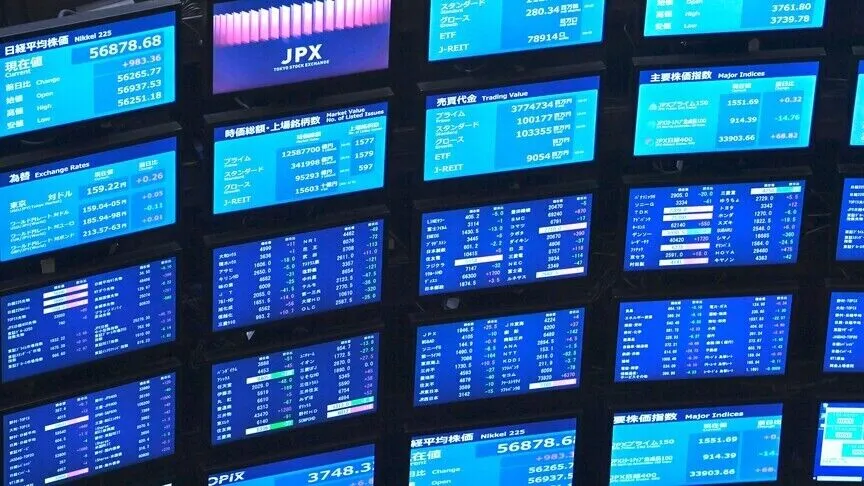
Near Tuesday’s close, Japan’s Nikkei 225 dropped 0.5%, South Korea’s Kospi fell 1.5%, and Hong Kong’s Hang Seng contracted 0.8%, while China’s Shanghai Composite gained 0.2%.
