

İSTANBUL
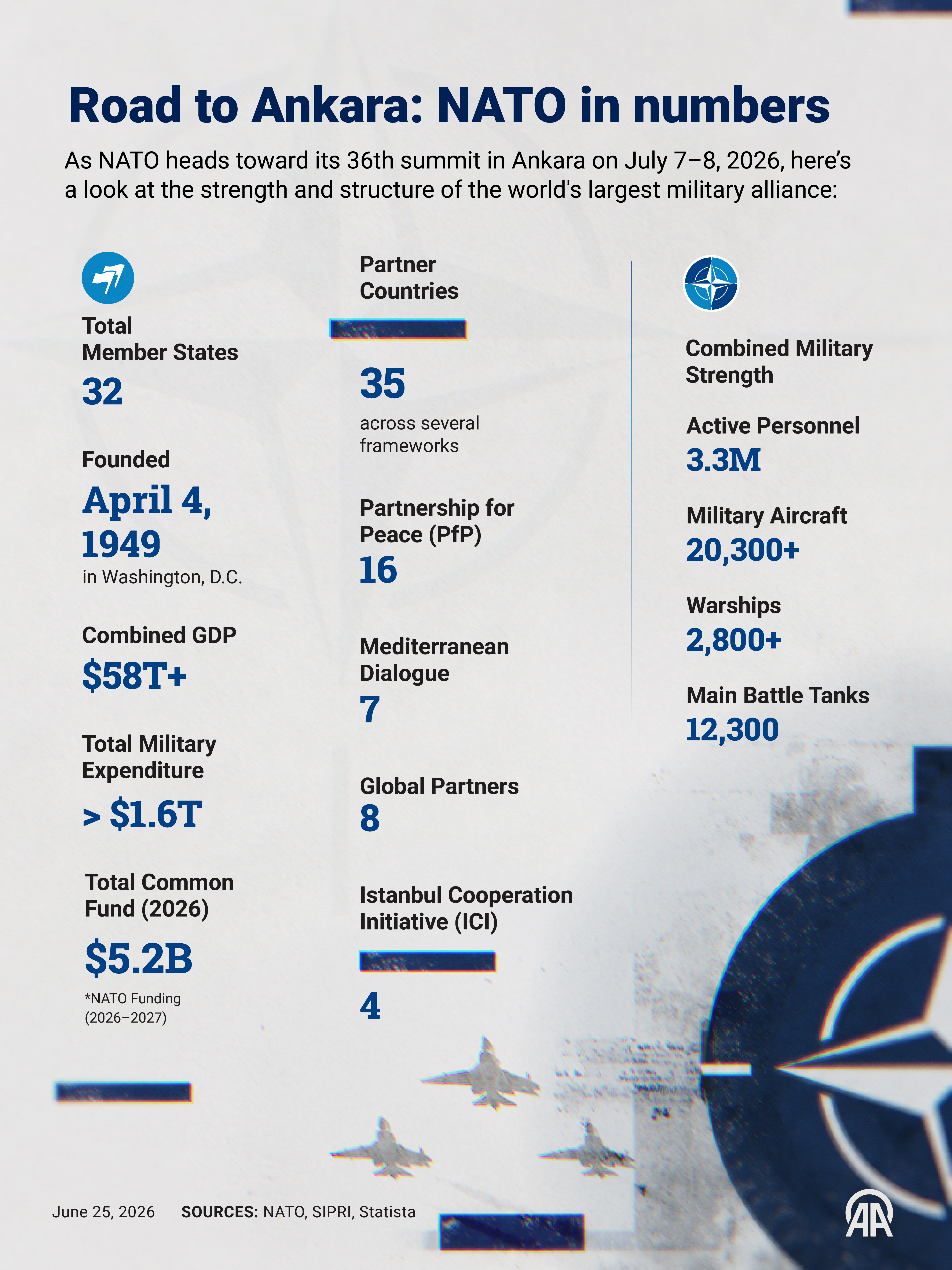
- With 3.3 million active personnel, $1.6T combined budget, 32-nation alliance commands 55% of global military spending
- Backed by a combined GDP of $58T, alliance protects a total population of nearly 1B across continents
- Alliance leaders head to 2026 Ankara summit to review national defense roadmaps amid shifting political dynamics in Washington
As NATO heads toward its 36th summit in Ankara on July 7–8, the world’s most powerful military alliance presents a striking set of numbers.
The alliance’s 32 member states field more than 3.3 million active troops and spend over $1.6 trillion annually on defense, representing roughly 55% of global military expenditure, according to SIPRI.
Here is a look at NATO by the numbers.
Alliance in brief
NATO, the North Atlantic Treaty Organization, was founded on April 4, 1949, in Washington, D.C., when 12 countries signed the North Atlantic Treaty.
Headquartered in Brussels, Belgium, the alliance binds North America and Europe under a commitment to collective defense. Its operational cornerstone is Article 5 of the Washington Treaty: an armed attack against one member is treated as an attack against all.
The founding 12 were Belgium, Canada, Denmark, France, Iceland, Italy, Luxembourg, the Netherlands, Norway, Portugal, the United Kingdom and the United States. Since then, NATO has grown through 10 rounds of enlargement.
The first expansions saw Greece and Türkiye join in 1952, followed by West Germany in 1955 and Spain in 1982. After the collapse of the Soviet Union, the alliance underwent a dramatic eastward shift. Czechia, Hungary and Poland joined in 1999, followed by the 2004 wave, which brought in Bulgaria, Estonia, Latvia, Lithuania, Romania, Slovakia and Slovenia, making it the largest single enlargement in NATO’s history.
Integration continued in the Balkans with Albania and Croatia joining in 2009, Montenegro in 2017 and North Macedonia in 2020.
The most recent additions are Finland, which joined in 2023, and Sweden, which became the 32nd member in 2024. Both accessions were directly triggered by Russia’s war in Ukraine in February 2022. Finland’s entry alone extended NATO’s direct land border with Russia by 1,340 kilometers (about 832 miles) overnight.
Iceland is the only member with no standing army, contributing through its coast guard, police and civilian specialists. Three members, the US, France and the UK, hold independent nuclear deterrents, while the US also maintains nuclear-sharing arrangements with several European allies.
Bosnia and Herzegovina, Georgia and Ukraine have all formally declared their aspiration to join. None has a confirmed accession timeline.
Comparison with Russia
NATO’s collective military machine vastly outpaces any single adversary.
As of 2025, alliance members together have approximately 3.3 million active military personnel compared with Russia’s roughly 1.32 million. NATO operates around 20,375 military aircraft to Russia’s 4,237, deploys more than 2,800 warships against fewer than 750, and fields nearly 12,300 main battle tanks to Russia’s 5,600, according to Statista.
The US remains NATO’s dominant force, with approximately 1.3 million active personnel. Among European members, Türkiye fields the largest army at around 370,000 active troops, followed by Poland at 252,00, France at 201,000, Germany at 182,000, Italy at 193,000 and the United Kingdom at 126,000, according to the secretary general’s annual report 2025.
Reserve capacity adds considerable depth, Finland, for example, can mobilize nearly 870,000 reservists despite having only around 24,000 active soldiers.
Collectively, NATO members represent a combined GDP of over $58 trillion and a population of nearly one billion.
Defense spending: From 2% to 5%
The burden-sharing debate has defined NATO’s internal politics for decades, and the start of the Russia-Ukraine war in 2022 fundamentally accelerated its resolution.
At the 2014 Wales Summit, convened in the aftermath of Russia’s annexation of Crimea, NATO leaders agreed a Defense Investment Pledge calling on all members to move toward spending at least 2% of gross domestic product (GDP) on defense. At the time, only three allies met that threshold.
By 2025, all 32 members are expected to meet or exceed the 2% target, according to a NATO report. Secretary General Mark Rutte said the numbers were “clear,” noting that European Allies and Canada had increased their core defense investment “by over 90 billion dollars,” adding that “these significant investments are producing real capabilities.”
European allies and Canada collectively invested $657 billion ($574 billion in constant 2021 prices) in defense in 2025, a 20% jump from the previous year, while the US contributed $980 billion, bringing the total to over $1.6 trillion in current prices.
The US remains the financial backbone, accounting for roughly 60% of the alliance’s total defense budget. Germany, for the first time in years, surpassed the 2% GDP threshold in 2024. The UK contributed approximately $92 billion, France $68 billion and Türkiye $36 billion.
Poland leads all members in defense burden as a share of GDP, allocating 4.3%, the highest of any NATO ally, while Latvia came in at 3.74% and Lithuania at 4%. At the other end of the scale, countries like Albania, Belgium, Canada, Portugal and Spain have a 2% GDP spending on defense
In a historic first, Norway in 2025 surpassed the US in per-capita defense spending, allocating more than $3,000 for each citizen. Albania and North Macedonia, on the other hand, spent less than $200 per-capita.
The Hague commitment: A new 5% target by 2035
At the 2025 NATO Summit in The Hague, allied leaders committed to spending 5% of GDP annually by 2035. The formula is two-tiered: at least 3.5% on core military expenditures, personnel, operations, equipment and maintenance, and up to 1.5% more on security-related items such as cyberdefense, supply chain resilience and critical infrastructure.
For context, Russia’s entire defense budget, at the extraordinary rate of 7.5% of GDP, amounts to around $190 billion, roughly one-eighth of what NATO collectively spent in 2025, according to SIPRI. China, meanwhile, spent $336 billion in 2025, which corresponds to 1.7% of their GDP.
How NATO is funded
Beyond national defense budgets, NATO operates shared common funds covering the organization itself, its command structure and collective military infrastructure.
The common fund stood at around €4.6 billion ($5.2 billion) for 2025, rising to €5.3 billion euros for 2026, just 0.3 % of total allied defense spending, yet it covers NATO’s civilian headquarters, the Military Command Structure, air and naval basing facilities, satellite communications and fuel pipelines.
Contributions are formula-based, derived from each member’s Gross National Income. For 2026–2027, the US and Germany each carry the largest shares at 14.9% apiece, followed by the United Kingdom at 10.3%, France at 10.1% and Italy at 7.9%. Albania, North Macedonia, Montenegro and Iceland carry the smallest share at around thousandth the funding.
The military budget for 2026 stands at €2.42 billion euros, while the NATO Security Investment Programme (NSIP) ceiling is € 2.2 billion euros.
Partners
NATO’s reach extends well beyond its 32 members. The alliance maintains relations with 35 non-member partner countries through several frameworks.
The Partnership for Peace (PfP) includes 16 partner countries in the Euro-Atlantic area, among them former Soviet republics such as Armenia, Azerbaijan, Georgia, Kazakhstan and Ukraine, alongside neutral European states including Austria, Ireland and Switzerland. Russia and Belarus are listed as PfP members but their partnerships are suspended following North Atlantic Council decisions related to the war in Ukraine.
The Mediterranean Dialogue links NATO with seven countries in the wider Mediterranean region: Algeria, Egypt, Israel, Jordan, Mauritania, Morocco and Tunisia. The Istanbul Cooperation Initiative (ICI) offers four Gulf Cooperation Council states, Bahrain, Kuwait, Qatar and the United Arab Emirates, a cooperation framework. NATO also works individually with “Partners Across the Globe” such as Australia, Japan, South Korea, New Zealand and Colombia.
Ankara summit and current tensions
The 2026 Ankara summit will be only the second NATO summit hosted by Türkiye, following the 2004 Istanbul gathering. Key agenda items include further assistance to Ukraine, defense spending roadmaps and the long-term direction of the alliance.
The summit convenes under significant internal strain. Since US President Donald Trump’s re-election in 2024, the alliance has faced an unprecedented rift between Washington and most other allies. In March 2026, Trump called NATO allies “cowards” for declining to support efforts to reopen the Strait of Hormuz during Israeli-US strikes on Iran, dismissing the alliance as a “paper tiger” that would be ineffective without US involvement.
How those tensions shape the Ankara summit’s outcomes may be the defining question when leaders gather on July 7.
