
MUĞLA
Archaeologists excavating a 5,000-year-old settlement in southwestern Türkiye have uncovered volcanic glass from the Greek island of Melos, providing new evidence of its overseas connections during the Early Bronze Age.
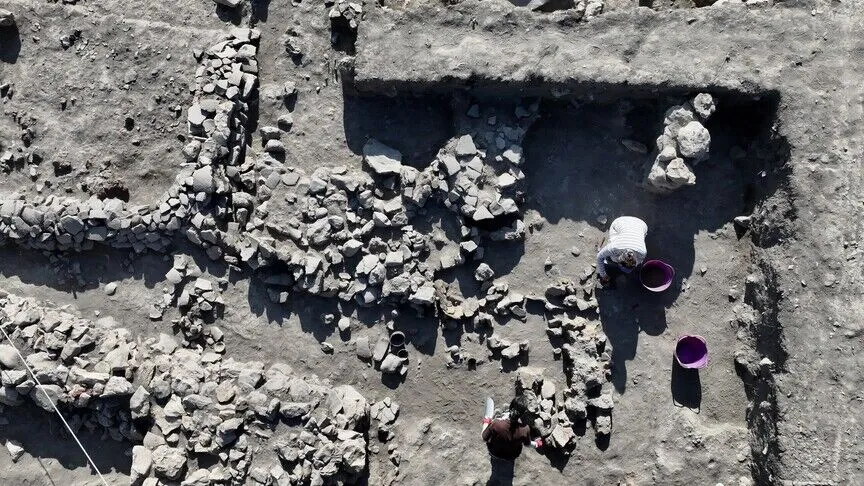
The obsidian, a naturally occurring volcanic glass prized in prehistoric times for making cutting tools, was discovered during excavations at Caltilar Mound in Mugla province. The site lies about 100 kilometers (62 miles) from the sea and sits at an elevation of 1,287 meters (4,222 feet).
The excavation, launched in 2021 and now conducted as part of Türkiye’s Culture and Tourism Ministry’s Heritage for the Future project, is led by Aysegul Aykurt of Hacettepe University.
This year’s excavation is focusing on a settlement dating to around 2400 BC.
“We recovered chipped stone artifacts made from Melos obsidian. This is important because it demonstrates the settlement’s overseas connections,” Aykurt told Anadolu.
The obsidian came from the volcanic Greek island in the Cyclades, one of the Aegean’s best-known prehistoric sources of the material. Archaeologists also uncovered a fragment of a Cycladic frying pan and a spool-shaped weight linked to the western Aegean.
In the same archaeological layer, researchers found tools made from obsidian sourced from central Anatolia, indicating that the settlement also maintained connections with inland regions.
Aykurt said the inhabitants may have developed overseas connections through trade along the Esen River.
Excavations have identified eight occupation layers dating from around 3100 BC to 2400 BC. The earliest settlement was established on the surrounding plain roughly 5,300 years ago before moving onto the mound after nearby marshland dried up around 5,100 years ago.
Among the excavation’s other notable discoveries is an Archaic-period structure built on a stone foundation incorporating fragments of Late Bronze Age burial pithoi, or large storage jars used for burials.
Aykurt stressed that “No comparable example has been found in Anatolia so far.”
The team has also uncovered ceramics from the ancient regions of Lycia, Caria, Lydia and Ionia.
Aykurt said the diversity of the finds does not correspond with the site’s architecture. She said the team believes the settlement may have been inhabited by a group connected to, or influenced by, a power that controlled the main source regions of the materials.
