
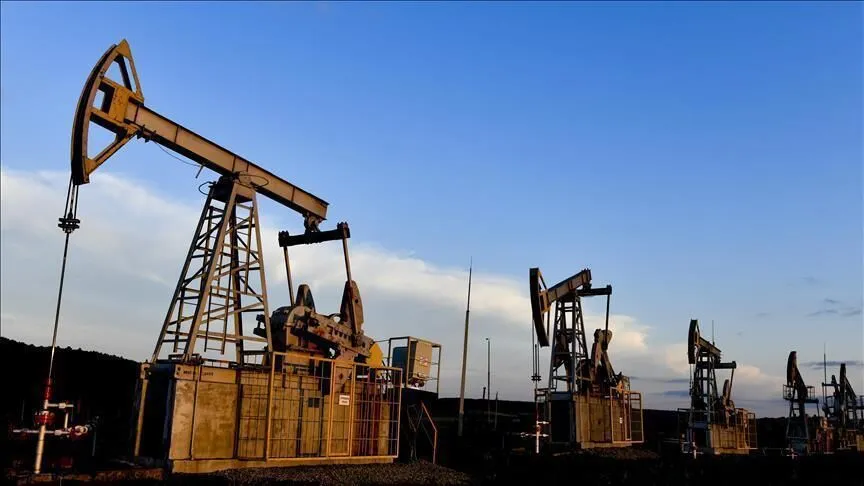
Brent crude edged lower in early trading on Thursday after a sharp rally fueled by escalating US-Iran tensions, as investors took profits while continued concerns over potential supply disruptions kept prices supported.
International benchmark Brent crude traded at $77.81 per barrel at 9.47 a.m. local time (0647 GMT), down around 0.3% from the previous close of $78.02.
US benchmark West Texas Intermediate (WTI) fell about 0.2% to $73.33 per barrel from $73.52 in the previous session.
Brent surged 8.7% on Wednesday, briefly climbing as high as $80.59 per barrel after US President Donald Trump declared that negotiations with Iran had ended, intensifying concerns over global oil supplies. Prices eased in early trading as investors locked in profits following the sharp rally.
The market remained supported after Trump ruled out further negotiations with Iran, while tighter US sanctions on Iranian oil exports and an expansion of US military operations against Iran reinforced expectations of tighter global crude supplies.
The US Treasury Department’s Office of Foreign Assets Control (OFAC) revoked the general license permitting Iranian oil sales following attacks on oil tankers in the Strait of Hormuz, while allowing previously authorized transactions to wind down through July 17.
Meanwhile, the expansion of US military operations against Iran heightened concerns over potential supply disruptions.
The US Central Command (CENTCOM) said on Wednesday that it had carried out airstrikes against around 90 Iranian military targets, including air defense systems, coastal surveillance assets, missile and drone storage facilities, naval assets and military logistics infrastructure.
CENTCOM also said approximately 80 military targets were struck during the first wave of attacks on July 7, including more than 60 fast attack boats belonging to Iran’s Islamic Revolutionary Guard Corps (IRGC).
Iran responded with strong warnings. Ebrahim Azizi, chairman of the Iranian parliament’s National Security and Foreign Policy Commission, said the US should expect a “crushing response” and warned that Americans “would not be safe anywhere in the world.”
Israel also raised its military alert level following the US strikes, with local media reporting that the country’s military had strengthened its air defense systems and heightened overall readiness against possible retaliatory attacks from Iran or Lebanon.
Analysts said renewed tensions surrounding the Strait of Hormuz and the intensifying military confrontation between the US and Iran have increased the geopolitical risk premium in global oil markets, helping support prices despite Thursday’s modest pullback.
– Fed policy expectations cap gains
Expectations surrounding US Federal Reserve monetary policy also remained a key influence on oil prices.
Minutes from the Fed’s latest meeting, released on Wednesday, showed that most policymakers believe further interest rate increases could become necessary if inflation remains elevated due to strong demand associated with artificial intelligence, persistent Middle East conflict or the effects of tariffs.
Expectations that tighter monetary policy could slow economic activity and weaken fuel demand continued to limit further gains in oil prices.
