
Moscow
Russia and China on Wednesday expressed concern over what they described as “the growing militarization of the Arctic by the US and its allies.”
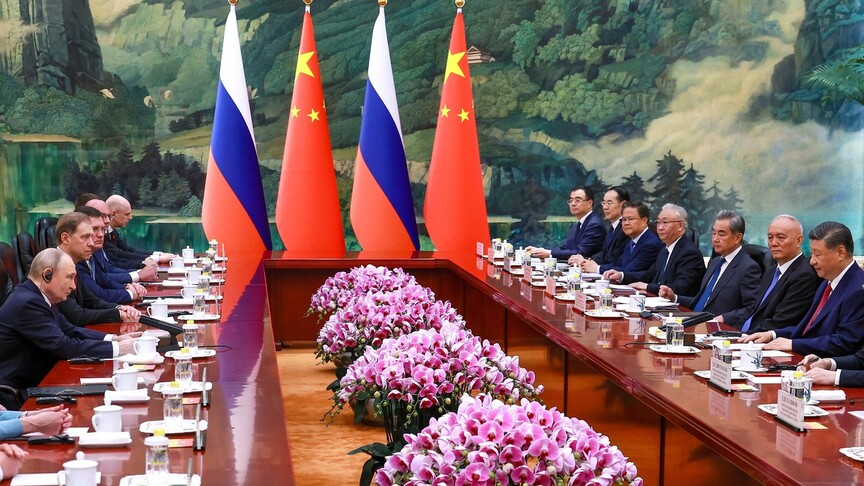
In a joint declaration on further enhancing comprehensive strategic coordination and deepening good-neighborliness and friendly cooperation, adopted following talks between Russian President Vladimir Putin and his Chinese counterpart Xi Jinping in Beijing, the two countries stressed the importance of respecting the sovereignty and territorial integrity of Arctic states.
Moscow and Beijing said they were interested in preserving the Arctic as “a territory of peace, stability and low military-political tension.”
“The parties express concern over the militarization of the high latitudes by the United States and its allies, reaffirm their commitment to the norms of international law in the Arctic,” it said.
The statement also emphasized the importance of developing “constructive dialogue and mutually beneficial cooperation” in the region through multilateral mechanisms, including the Arctic Council.
The remarks come amid increasing geopolitical competition in the Arctic, where Russia, the US and NATO countries have all expanded military activity and strategic planning in recent years.
Warning against return to ‘law of the jungle’ in global affairs
Russia and China warned against a return to the “law of the jungle” in international affairs and opposed hegemonic practices, unilateral sanctions, and external interference in the internal affairs of sovereign states.
The two countries said terrorism continued to pose “a significant threat” to Afghanistan, the broader region and the world, urging neighboring states and the international community to strengthen bilateral and multilateral counterterrorism cooperation with Kabul.
Moscow and Beijing also backed Afghanistan’s counterterrorism efforts and pledged stronger coordination on Afghan issues through multilateral platforms like the Moscow format, the Russia-China-Iran-Pakistan quartet, and the Shanghai Cooperation Organization (SCO).
In the statement, the two countries said the US and Israeli military strikes on Iran violated international law and “seriously undermine stability in the Middle East.” Moscow and Beijing called on all parties involved to return to dialogue and negotiations as soon as possible in order to prevent further escalation.
Russia and China also voiced support for achieving a sustainable ceasefire in Gaza and reaffirmed commitment to a “comprehensive, just and sustainable” settlement of the Palestinian issue based on the two-state solution, including the establishment of an independent and territorially integral Palestinian state.
The statement expressed support for Syria’s sovereignty, independence and territorial integrity, saying the Syrian transitional government must “resolutely resist all forms of terrorism and extremism.”
On Africa, the declaration said the continent possessed “significant development potential in the 21st century” and backed efforts by African states to achieve the goals of the African Union’s Agenda 2063 strategy.
Russia and China reject unilateral sanctions, oppose interference in internal affairs
The two countries opposed the use of coercive economic measures and pledged to expand cooperation with African states and regional organizations, particularly the African Union.
Russia and China also reaffirmed support for Latin America and the Caribbean as a “zone of peace,” backing the region’s right to choose independent development paths and partners while opposing external interference in the internal affairs of regional states.
The two sides said no country or people is “first-class,” affirming all sovereign states have equal security rights, rejected forcing countries to abandon neutrality, and opposed using human rights as a pretext for interfering in internal affairs.
The declaration expressed concern over what it described as the militarization policies of the US and its allies, including NATO’s growing activity in the Asia-Pacific region, which Russia and China said was incompatible with strengthening peace and stability.
The two countries also voiced concern over Japan’s accelerated remilitarization and criticized the “confrontational rhetoric” of certain states, calling for an end to interference in Russian and Chinese internal affairs.
Russia and China reaffirmed support for the authority of the UN in international affairs and opposed attempts to return to a world order “where only might prevails.”
The declaration also rejected unilateral sanctions and discriminatory tariffs not approved by the UN Security Council, while condemning initiatives involving the blocking, seizure or confiscation of foreign state assets.
On security issues, Russia said it valued China’s “objective and impartial” position on Ukraine, while both countries opposed pressure on North Korea.
Moscow and Beijing also warned that restrictions on shipping imposed by “individual states” threatened global trade and supply chains.
The two nations pledged to deepen cooperation in advanced technologies, including thermonuclear fusion and fast neutron reactors, and agreed to ensure compatibility between Russia’s GLONASS and China’s BeiDou satellite navigation systems.
The declaration stressed that immunity for heads of state from criminal prosecution remains an important guarantee for stable international relations.
