
ISTANBUL
- ‘We are right now in the midst of the single largest serial killer, mass murder campaign against journalists in human history,’ says Jeremy Scahill
- ‘The perception of Israel and the broader Zionist project has never been in a greater crisis,’ he says
Western media coverage of Gaza and Iran is shaped by a “dehumanizing” narrative that distorts conflict reporting, investigative journalist Jeremy Scahill said.
“The entire thing is about dehumanizing both Iran and the Palestinians. It’s an inversion of reality,” Scahill, co-founder of Drop Site News, told Anadolu.
He said mainstream media is being used by governments as a political tool to justify their actions.
“In the post-9/11 world, the United States still was holding on to the idea that it was going to make an argument that this is legal, that there are hostile threats and terrorists in the world that must be confronted. With Donald Trump, they don’t even pretend anymore.”
Palestinian deaths not ‘collateral damage’
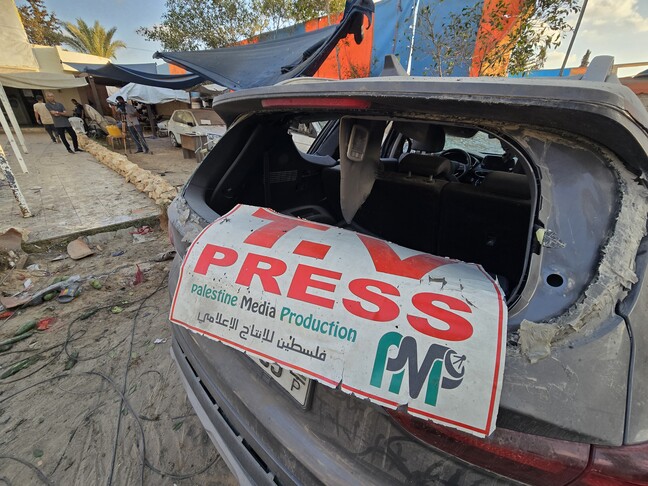
Scahill, author of Blackwater: The Rise of the World’s Most Powerful Mercenary Army, also condemned what he described as unprecedented violence against journalists in Gaza.
The book, which The New York Times described as a “crackling expose,” examined the rise of private military contractor Blackwater and its role in US wars in Iraq and elsewhere.
“We are right now in the midst of the single largest serial killer, mass murder campaign against journalists in human history.
“More than 300 Palestinian media workers have been killed, many of them intentionally.”
He rejected the framing of such deaths as wartime “collateral damage,” calling them instead “an actual serial killer campaign aimed at murdering journalists whose crime is being the eyes and ears of the world.”
Scahill also criticized what he described as the silence of Western media organizations, saying it amounted to complicity.
“There’s also in some ways a more devastating and dangerous category, and that is journalists who have been silent in the face of the killing of our colleagues.
“Most major Western news organizations have said absolutely nothing about the mass killing of our Palestinian journalist colleagues.”
But one positive development, Scahill said, is that traditional media’s dominance has been weakened.
“These huge media organizations, their monopoly on the dissemination of information has been shattered,” he said, adding that “independent journalism is rising.”
“Palestinians, by filming the genocide of their own people, served as the eyes and ears of the world,” Scahill said, adding that big media corporations no longer have “the power to filter any of it.”
Calling Gaza “the first live-stream genocide in history,” the 51-year-old journalist said that “the perception of Israel and the broader Zionist project has never been in a greater crisis.”
Speaking to the other side
Scahill warned against the growing criminalization of speaking to the “other side.”
Having interviewed members of Hamas, Hezbollah and Iranian leaders, he defended the practice as a core responsibility of journalism, saying it would be “journalistic malpractice” not to speak to people who are framed as “villains.”
He said that when media narratives create a “cartoonized version” of Palestinian resistance or portray Iran as being run solely by the Islamic Revolutionary Guard while ignoring its internal diversity, it distorts public understanding of conflict.
In his view, such framing “sets people up to be shocked” by real-world responses, including Iran’s “retaliatory strikes” after leadership assassinations.
For him, journalists must go to the “other side of the gun, the American gun, that is pointed at the rest of the world and interview the people that live on the other side of it.”
On Iran, he said Western narratives misrepresent Tehran’s position in negotiations.
“In the case of Iran, you have Trump saying that the Iranians are begging him to make a deal, and yet at every turn it’s the Iranians who are refusing to give up their sovereignty.”
