
RAMALLAH, Palestine (AA)
- Local elections framed as step in ‘bottom-up’ reform to improve accountability and renew legitimacy
Palestinians are heading to the polls on Saturday in local elections covering 183 municipalities in the West Bank and the Deir al-Balah municipality in the Gaza Strip, amid the absence of general elections and a landscape dominated by clan-based and service-oriented dynamics rather than partisan competition.
Around 1.04 million voters, representing 67% of registered voters, are participating in the elections, which are being held for the first time in 22 years in Deir al-Balah in central Gaza, in what reflects an attempt to preserve the unity of the Palestinian administrative system despite the ongoing geographic and political division since 2007.
The elections are being held in Deir al-Balah as it is among the least damaged cities in Gaza following two years of Israeli war.
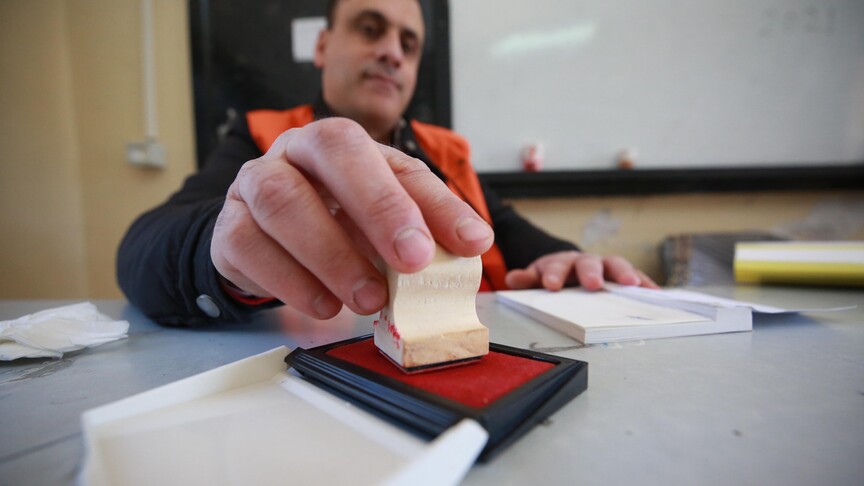
Voting is taking place at 1,922 polling stations across 491 centers, with more than 10,000 staff involved. A total of 197 local councils have already been decided uncontested, while no candidate lists or nominees were registered in 40 others, reflecting significant disparities in the level of competition.
Absence of factions, dominance of clans
The vote is being held amid ongoing Palestinian division, with the West Bank administered by the Palestinian Authority and the Gaza Strip under Hamas control.
Local elections were last held in the West Bank in 2021 in two phases, while the Cabinet postponed elections in Gaza “until appropriate conditions are met” due to the division.
Political analyst Ahmad Abu al-Haija said the elections are largely service-oriented with limited political impact, due to the absence of broad party participation, weakening their influence on the public.
Abu al-Haija told Anadolu that the electoral process is dominated by clan dynamics, with limited presence of alliances linked to Fatah movement, falling short of meaningful political competition capable of driving change.
He added that the elections represent a procedural requirement aimed at ensuring the continuity of local councils, without carrying deep political significance.
The expert warned that results may reinforce clan alliances at the expense of civil work, thereby entrenching the status quo.
Complex political landscape
Suleiman Basharat, director of the Yabous Center for Studies, told Anadolu the elections are being held amid unprecedented internal and political complexities linked to Israeli occupation.
He said the elections reflect a “clear decline” in the role of Palestinian factions, in favor of families, clans and individual competence, indicating a shift in electoral standards, where service performance has replaced political programs and party affiliation as the decisive factor.
Basharat added that Israeli actions, including settlement expansion, economic restrictions, arrests of candidates and pressure on others to withdraw, “directly affect the electoral process.”
He said these measures aim to weaken the institutional role of local councils and undermine their developmental and service functions as part of a broader policy to weaken the Palestinian political structure.
Reform track
Ahmad Rafiq Awad, director of the Jerusalem Center for Studies, said the local elections fall within a “bottom-up” reform process and represent both a popular and international entitlement aimed at enhancing transparency and renewing legitimacy.
He noted that the absence of several factions and parties, whether due to fear of results or rejection of the political framework, has allowed clans to dominate the electoral scene.
Awad added that this reproduces traditional structures, where clans compete instead of parties, reflecting a model closer to “pre-state” systems rather than a pluralistic political order.
In a notable indication, the inclusion of Deir al-Balah municipality in Gaza reflects the persistence of the idea of a unified Palestinian political system despite division, and the continued presence of the broader national project.
Deir al-Balah participation in Gaza
Jamil al-Khaldi, regional director of the Central Elections Commission in Gaza, said the process will take place across 12 polling centers with 100 stations, despite major logistical challenges caused by war-related destruction.
He told Anadolu that the commission is fully prepared to receive voters on election day. Al-Khaldi explained that polling stations are distributed geographically across Deir al-Balah to ensure accessibility.
Deir al-Balah was selected as it is relatively less damaged compared to other areas in Gaza, despite suffering destruction during the Israeli war.
According to official statistics, the war has killed around 72,000 Palestinians and injured more than 172,000, while damaging 90% of Gaza’s infrastructure.
Al-Khaldi said the ballot paper includes four competing electoral lists, with voters required to choose one list and then select up to five candidates within it.
He added that nine out of the 12 polling sites are open spaces equipped with temporary tents due to the lack of suitable buildings, with support from the United Nations Development Programme.
Regarding security, he said responsibility for securing the elections lies entirely with Palestinian police in Deir al-Balah, including protecting polling centers and transporting ballot boxes.
Other entities will play a purely logistical role, with emphasis on ensuring the process proceeds without direct security intervention to guarantee voter safety.
*Writing by Rania Abushamala in Istanbul
