
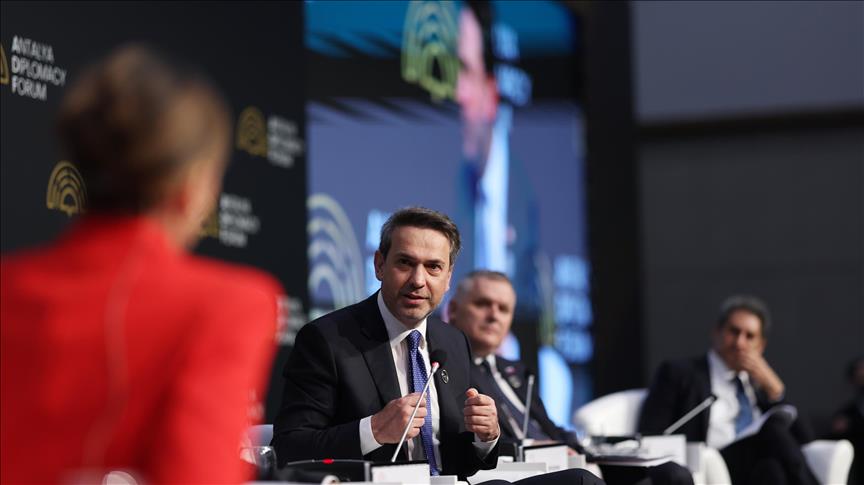
Türkiye is resilient due to the past crises such as climate change, pandemic, supply chain disruptions, high energy and commodity prices and surrounding wars, Energy and Natural Resources Minister Alparslan Bayraktar said Friday.
“The policies that we develop and the vision that we put forward made us really more resilient and secure in terms of these types of prices,” Bayraktar said, while speaking to reporters on the sidelines of the Antalya Diplomacy Forum (ADF).
“We transformed our markets to resemble private investment and private initiatives. We built huge infrastructure and put the diversification at the very core of our energy strategy,” he added.
Bayraktar noted they have carried out highly successful projects with Azerbaijan and neighboring countries, adding that they have managed to meet long-term energy needs through this strategy.
He said Türkiye’s energy strategy is shaped by three main challenges: rapidly growing demand, high import dependency, and decarbonization goals.
Bayraktar highlighted that energy demand in Türkiye has been rising steadily and is expected to continue growing in the coming decades.
“AI-driven systems and electric vehicles are increasing energy needs. We want to reduce our import dependency, as imports are a key driver of Türkiye’s current account deficit,” he said.
He emphasized that diversifying energy resources is a priority, adding that Türkiye seeks to expand the use of renewable energy and further develop technologies in wind, solar, and nuclear energy, including plans for small modular reactors (SMRs).
– Smart transition and infrastructure push
Bayraktar said Türkiye aims to expand its energy capacity without turning its back on fossil fuels, stressing the need for a more balanced and realistic energy transition.
“Our natural gas and oil pipelines continue to operate effectively. We need a new energy architecture. The energy transition is inevitable, but it must be a smart transition,” he said, adding that crisis management and supply security must remain central.
Bayraktar underlined the importance of existing infrastructure, including the Iraq-Türkiye oil pipeline, which holds significant spare capacity that could be utilized with further investments, alongside efforts to enhance regional energy connectivity.
He also noted that Türkiye has also launched its first deep-sea drilling operations off Somalia, as part of its broader strategy to expand upstream oil and gas activities globally.
Bayraktar said while the world faces fossil fuel-related risks, energy flows are not limited to a single route, and demand for reliable supply remains high.
He emphasized that these realities require rational and well-planned policies, underlining that Türkiye will continue using oil and natural gas while also increasing its renewable and nuclear energy capacity.
Bayraktar said investments in major international projects such as the Southern Gas Corridor, highlighting that such initiatives require strong political and economic will.
He noted that Türkiye needs to enhance its connectivity capacity, noting that the country is developing projects with partners such as Saudi Arabia, diversifying routes, and investing more in infrastructure.
He added that energy crises are likely to persist in the coming years, stressing the need to draw lessons and take the necessary steps at the national level.
Bayraktar emphasized that reducing dependency, increasing capacity, ensuring security, and improving storage of renewable energy will play a critical role in reaching these goals.
He also noted that efforts to boost energy efficiency are ongoing in cooperation with both public and private sector stakeholders, adding that a major announcement on targets could be made in the near future.
“We have a strong target to achieve a carbon-neutral economy by 2050, with around 30 years ahead. We will see transformation across transportation, infrastructure, and agriculture,” he said, describing renewable energy as the key driver of this transition.
He added that Türkiye may bring forward its 2050 carbon-neutral target to 2035, although the plan has not yet been finalized, and noted that efforts to improve energy efficiency are being carried out in cooperation with both public and private sector stakeholders.
